Biogeochemical Sensor Development
We are always striving to invent new technologies, especially in the low-cost and open source spaces. Main scientific topics of interest include: blue carbon and ocean acidification, eutrophication, and other water quality issues. More specifically, we are working on sensors and analyzers to measure pH, pCO2, O2, total dissolved inorganic carbon, chlorophyll fluorescence, colored dissolved organic matter, and turbidity/backscattering. You can find much more information about these under the Peer-Reviewed publications header of the CV page.
Sensors in the Pipeline
We currently have several sensors under development; here are some short descriptions:
- a multi-parameter bio-optical sensor named DockEye based off of open-source designs in the literature github.com/COAST-Lab/DockEye;
- an upgrade to OWL, our Open Water Level sensor with a tipping bucket for rainfall monitoring github.com/COAST-Lab/Open-Water-Level-and-Rainfall-Sensor;
- a device that combines off-the-shelf water quality instrumentation in a comparatively low-cost multiparameter sensor, integrated into a coastal drifter github.com/COAST-Lab/Biogeochemical-Drifter;
- a collaboration with Sunburst Sensors wherein we are working improve validation, IoT networking, and data visualization for their pHyter (renamed MOBI-pH), a low-cost spectrophotometric pH sensor.
Please check back for updates as these technologies continue to evolve!
Published Technologies:
The Sensor for the Exchange of Atmospheric CO2 with Water (SEACOW)
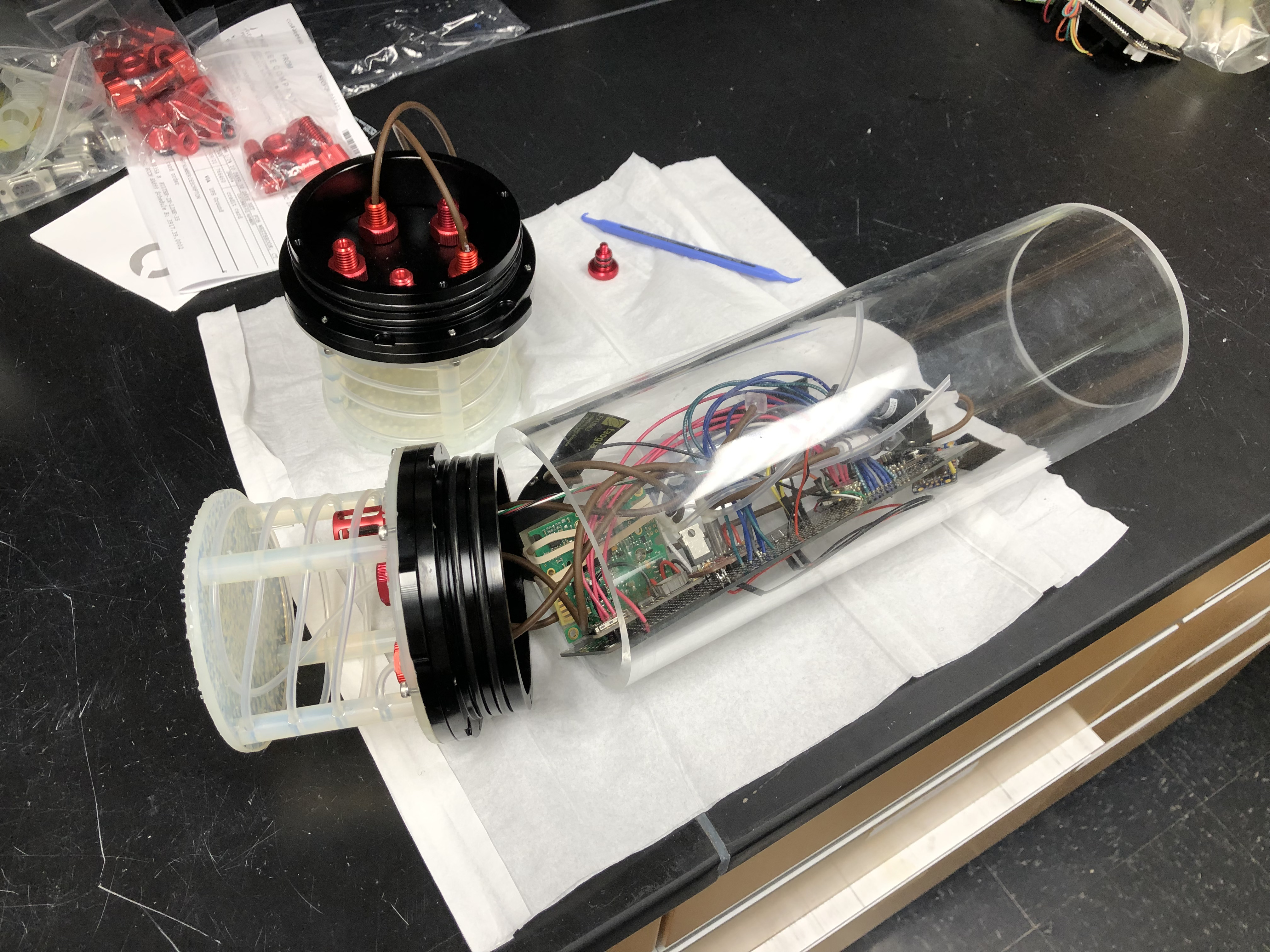
The ocean is one of the world’s largest anthropogenic carbon dioxide (CO2) sinks, but closing the carbon budget is logistically difficult and expensive, and uncertainties in carbon fluxes and reservoirs remain. One specific challenge is that measuring the CO2 flux at the air–sea interface usually requires costly sensors or analyzers (USD > 30,000), which can limit observational capacity. Our group has developed and validated a low-cost ΔpCO2 system, able to measure both pCO2water and pCO2air, for USD ~1400 to combat this limitation. The device is equipped with Internet of Things (IoT) capabilities and built around a USD ~100 pCO2 K30 sensor at its core.
Farquhar, E.*, Bresnahan, P.J. (corresponding author), Tydings, M.*, Jarvis, J.C., Whitehead, R.F., Portelli, D.* (2025). Developing a low-cost device for estimating air–water ΔpCO2 in coastal environments. Sensors. 25(11), 3547. doi.org/10.3390/s25113547.
Bresnahan, P.J., Farquhar, E.*, Portelli, D.*, Tydings, M.*, Wirth, T., Martz, T.R. (2023). A low-cost carbon dioxide monitoring system for coastal and estuarine sensor networks. Oceanography 36(Supplement 1), doi.org/10.5670/oceanog.2023.s1.4.